

01
Acquire
Mira continuously gathers signals to identify opportunities and understand evolving customer trends and preferences, helping organizations refine who they reach, when they reach them, and how relationships begin.
Mira brings together the intelligence, persistent memory, orchestration, execution and governance required to deploy autonomous agents across the entire Customer Lifecycle.
It connects to the systems and data organizations already use, builds an evolving understanding of every customer, and enables agents to take action, while organizations maintain governance, oversight and control.
Running Mira today: FinPoints, Alibaba Group, Morph, Ctrl Media Limited, Prestige Partners Trading, Surplus, Behave, Pika, Massachusetts Institute of Technology.
Customer context is distributed across systems, conversations, transactions, workflows and teams. Mira brings that context together through one agent platform so understanding can move continuously across acquisition, engagement, retention and growth.
Mira continuously gathers signals to identify opportunities and understand evolving customer trends and preferences, helping organizations refine who they reach, when they reach them, and how relationships begin.
Mira coordinates conversations, follow up, recommendations, workflows and actions using the evolving context of each relationship, learning from outcomes and changing conditions.
Persistent customer memory preserves preferences, history, commitments, interactions and outcomes so every engagement can build on what came before.
Mira uses the accumulated understanding of each relationship to identify relevant opportunities for deeper engagement, expansion or reactivation.
Four connected modules bring the Customer Lifecycle together with shared context, execution and governance.
Acquire. Identify opportunities, understand audiences, and initiate new customer relationships through the channels your organization controls.
Engage. Build customer understanding and coordinate conversations, follow up, recommendations and actions across the relationship.
Retain. Grow. Maintain relationships, recognize changes in customer behavior, reactivate engagement, and identify opportunities to create additional value.
Connect. Remember. Govern. The shared intelligence, persistent memory, system connections, permissions and governance behind every Mira agent.
See which agents are active, what work is underway, which decisions require human involvement, and what actions have already been taken. When human judgment is required, Mira brings the relevant context forward so teams can act without reconstructing the relationship from scratch.
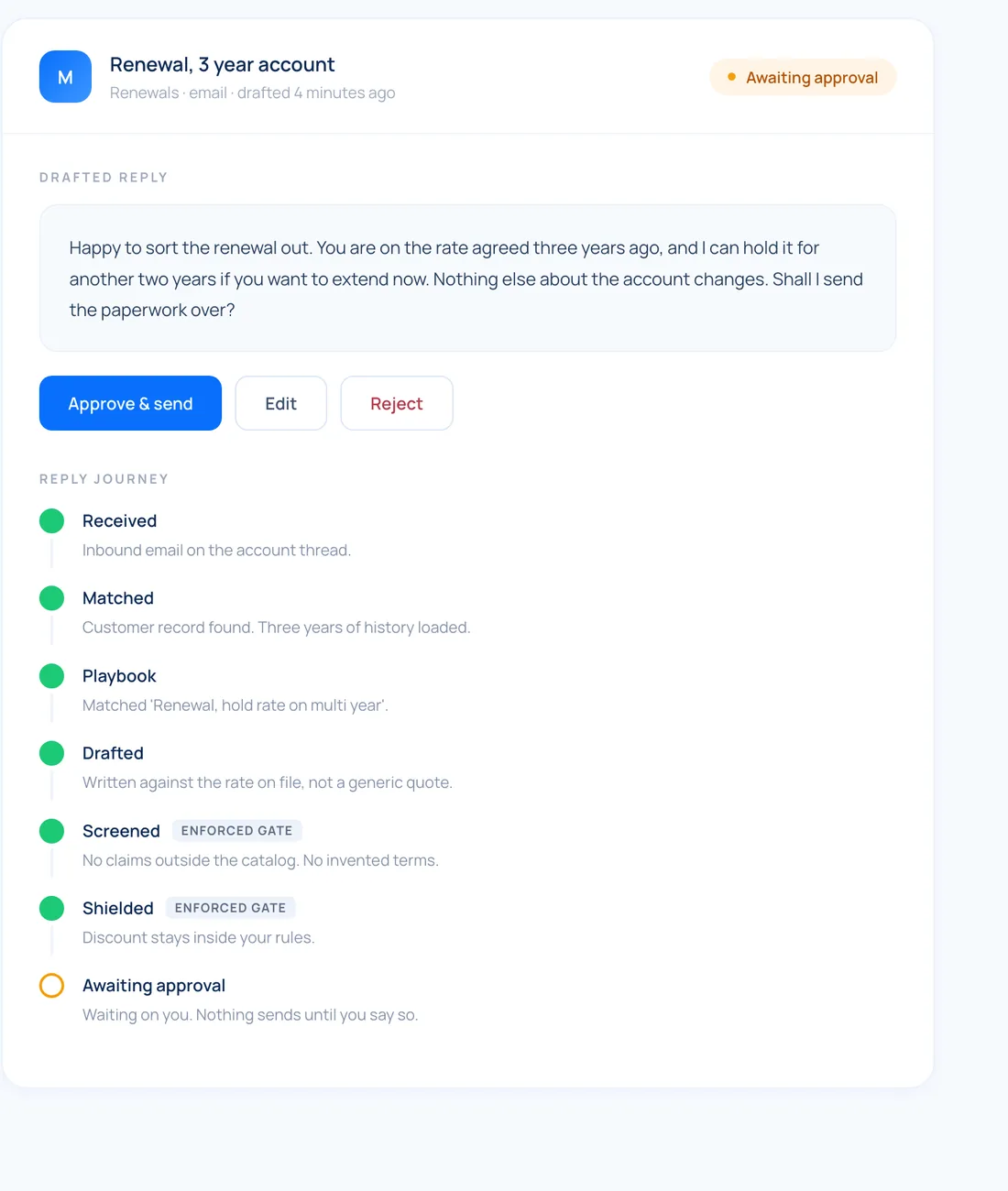
Mira drafts the reply. The decision stays yours.
Mira reads context from connected systems and coordinates actions across them, extending the technology organizations already rely on rather than replacing it. Your systems remain your sources of truth.
Mira maintains persistent customer memory across systems, channels, workflows and time so each interaction can build on what the organization already understands.
What is learned during acquisition informs engagement. Engagement strengthens retention. Retention creates opportunities for growth. And what those relationships teach can improve future acquisition.
Mira connects to existing customer, product, content and operational data rather than creating another disconnected source of customer context.
Organizations determine what Mira can operate autonomously, what requires approval, and what remains under human control. Governance is not added after execution. It is part of execution.
Actions can be evaluated against organizational policies, permissions, business rules, compliance requirements, approved information and brand standards before execution.
Sensitive actions can require human approval, while established workflows can operate independently. Those boundaries remain under the organization's control.
Customer facing facts can be verified against designated sources of truth before execution.
Agent actions can be logged with the relevant data, configuration, disclosures, approvals and execution context.
Mira is deployed inside your organization's environment, keeping customer data and deployment specific context under your control.
Mira runs inside your organization's environment, keeping customer data and deployment specific context under your control.
No usage data leaves your deployment.
The keys to your deployment stay with your organization.
Customer data is not used to train a shared Here AI model serving other customers.
More relationships managed per operator.
More opportunities to maintain and grow valuable relationships.
Customer engagement continues when teams are offline.
Fewer manual handoffs and less repetitive coordination.
Mira applies the same Acquire, Engage, Retain and Grow model to the systems, requirements and relationships of different industries.
Operate fan relationships continuously and at scale, with persistent context, creator specific voice, and audience protections built into execution. 120+ creators run fan conversations through Mira.
Learn more →Scale investor and client engagement with claims grounded in approved information, disclosures applied where required, and human oversight where appropriate.
Learn more →Engage every shopper with customer context and live product information, including pricing, availability, and inventory.
Learn more →Deploy Mira within institution controlled environments, with governance, security, oversight, and deployment requirements defined around the institution.
Learn more →
Run your Customer Lifecycle through Mira. Tell us where your customer relationships live today, the systems, data, channels and workflows involved, and where autonomous execution can create the most value. From there, we define how Mira connects to your organization and where governance, approval and human oversight apply.